Saturday, May 19, 2012

VOLTRI VII

B. Human beings are so unhappy  that tey would be bored even if they have no reason for boredom, simple because of their nature. They are so vain that with thousands of legitimate reasons for boredom the slightest thing like tapping a billiard ball with a cue is enough to distract them.

Blaise Pascal
Pensees and Other Writings


     Photography :SMO©2008
VOLTRI -VII
David Smith

For a while I thought I lost these pictures,  it must  be few years past since   I took 
them. I remember  it was  summer of 2008.   Couple friends from Argentina were 
in town for a short stay. One day before their  departure we  decided to take a day 
trip to Washington DC, the plan was to see the National Galery and come back at 
same day. After few hours drive from New York, we  arrived DC early afternoon. 
I park the car as close as I can get to  East Galery, I didn't  want to waste any time,
the outside the hot air mixed with high  humidity made our short  walking difficult.
Atrium of the East Galery felt cool and refreshing. Angular stone walls of Atrium
covered with playfull reflections of light coming through skylight  above. Quickly 
we head up to second floor. There I saw the Voltri first time. It had a true presence 
It was a sizeable sculpture,   about 10  feet  long and may be seven feet high, built 
from Iron, yet it seemed weightless. Later, I found out this was one of the twenty-
seven  sculpture David Smith  produced   amazingly short  period of time; during 
the thirty day stay in Spoleto, Italy in 1962.

Below chronological information provided by David Smith Estate


1962-63
Smith is invited by the Italian government to make two sculptures for exhibition in Spoleto during the Fourth Festival of Two Worlds in June 1962. He is offered as his studio a decommissioned Italsider steel factory in Voltri outside Spoleto and provided with a team of steel workers as his assistants. With these resources, Smith makes twenty-seven sculptures in thirty days, using the tools, machines, objects, and materials he found in the Italsider factory. Before returning to Bolton Landing, Smith arranges to have material from the factory shipped to New York. Upon his return, he begins his Voltri-Bolton series (twenty-five sculptures, 1962 to 1963).


Thursday, May 10, 2012

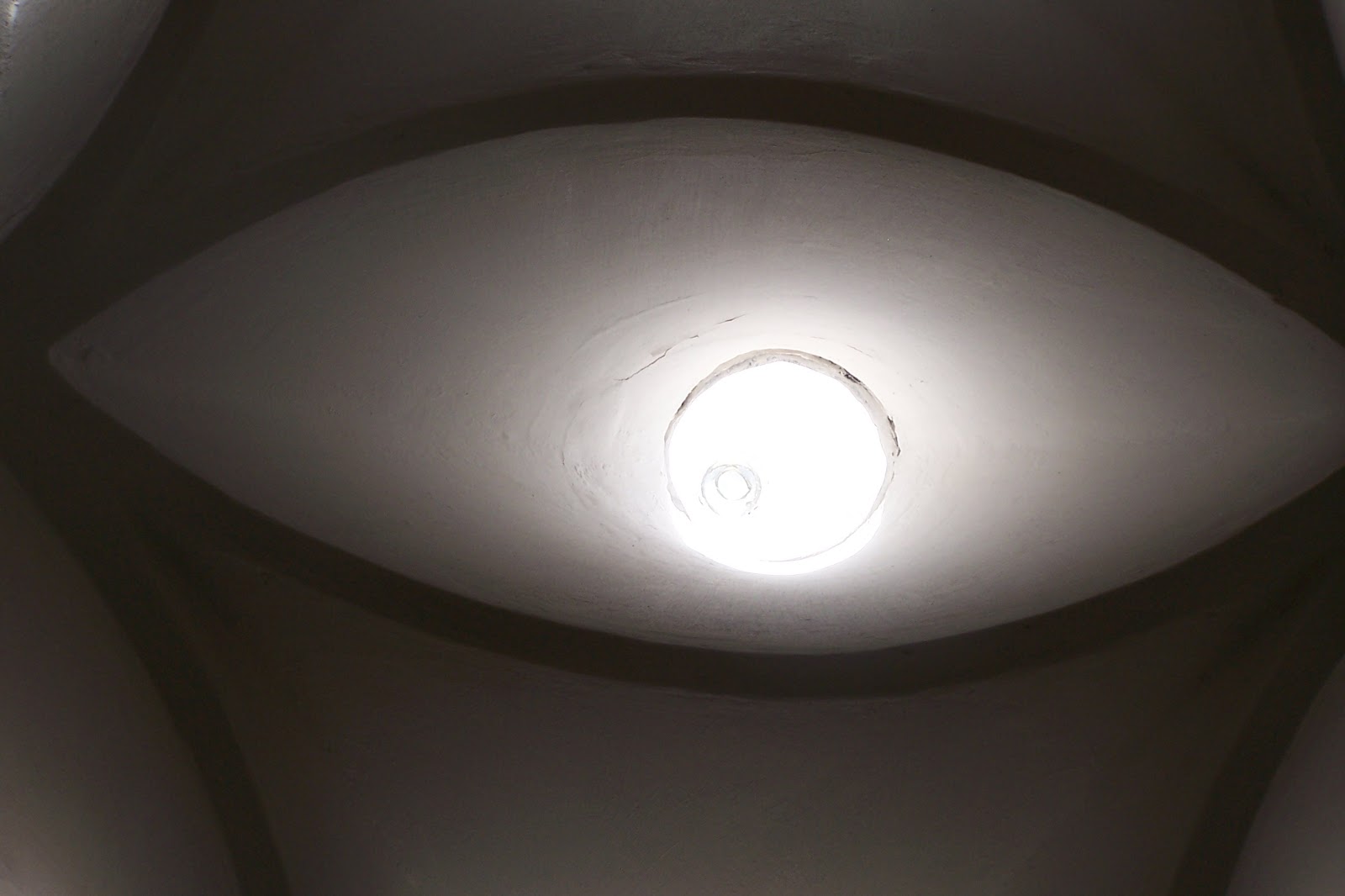
DOLMABAHCE SARAYI

CEILING SHOTS

One may ask-
 "What part of the palace is this?'
-it is the most utillitarian part
I would have replied-
you give me a confused look.
"It's the part that you get yourself
relieved from the all biological pressures."
I may add.

SMO©2012

Wednesday, May 2, 2012

FRAGMENTS OF NEW YORK STATE PAVILION

Observation towers of New York State Pavilion,  build for the New York World Fair 1964.
Towers was the tallest structure at the  fair (226'). Once beneath the towers is the Tent of tomorrow, worlds biggest suspension roof, comprised of hundred translucent panels held in place by elaborate network of steel cables, entire  roof structure supported by sixteen 100' tall concrete columns. The base of the pavilion covered by a giant map of New York State, pieced together by 4' x 4' terrazzo panels.
Almost half a century latter what left behind is rusted pile of steel, web of steel cables suspended in the mid air  and 16  concrete  columns circling around reminiscent to the ancient Stonehenge ruins
I visit the park last week to see a play at the recently renovated Queens Theatre in the park, which was originally designed by the architect Philip Johnson for the World Fair. Rotunda entrance hall of the the theatre surrounded by the high glass windows. Before the start of the show I bought myself  a cup of coffee, settled down on a chair  and watch the towers for a while. I felt that the rusted look of the structural steel, complex network of  cabling, pointed edge metal supports, all was giving these towers  mad max kind of futuristic look, in a long shot may be they were the left overs from a spaceship, accidently crushed on the earth some time ago.

SMO©2012

Tuesday, April 24, 2012

FOLD


"I don't have any idea of myself, not even the kind that consist in the lack of an idea of myself.
I'am a nomad in my self -awareness. The herds of my inner riches scattered during the first watch
The only tradgedy is not being able to conceive of ourselves as tragic. I've always clearly seen that 
I coexist with the world. I've never clearly felt that I needed coexist with it.
That's why I 've never been normal"
Fernando Pessoa- The Book of Disquiet

SMO©20012
What is immanence? A life... No one has described what a life is better than Charles Dickens,
if we take the indefinite article as an index of the transcendental. A disreputable man, a rouge,
held in contept by everyone, is found as he lies dying. Suddenly, those taking care of him manifest
an eagerness, respect, even love, for his slightest sign of life. Everybody bustles about to save
him, to point where, in his deepest coma, wicked man himself senses something soft and sweet
penetrating him. But to the degree that he comes back to life, his saviors turn colder, and he becomes
once again mean and crude. Between his life and his death, there is a moment that is only that of a
life playing  with death. The life of the individual gives way to an impersonal and yet singular life
that releases a pure event freed from the accidents of internal and external life, that is , from 
subjectivity and objectivity of what happens:  a " Homo tantum " with whom everyone empathizesand who attains a sort of beatitude. It is a haecceity no longer individuation but of singularization: a life
of pure immanence, neutral, beyond godd and evil, for it was only the subject incarnated it in the midst
of things that made it good or bad. The life of such individuality fades away in favor of the singular
life immanent to a man who no longer has a name, though he can be mistaken for no other. A singular
essence, a life...*
Gilles Deleuze
Pure Immanence


Reservoir Bridge


SMO©2012
Reservoir Bridge* crosses over the West 86th Street, near the Resorvoir. The wood cover walkway offers, quite moment of meditation for the pedestrians, exquisite cast-iron floral scroll which are design to emulate the surrounding green leafs, cordially salutes the life. There, in a brief moment, experience of a transcendental field comes back to live. It is not because of me, or the next one; nor  that of the bridge itself is perpetrate the experience; but  an impersonal  consciousness....without a self  does it for us.


*Designed by Calvert Vaux, 1864 


Monday, April 23, 2012

Urban Landscapes

     Manhattan is a utilitarian polemic.
REM KOOLHAAS

Thirty-four years passed since the first publication of Delirious New York in 1978
The book itself was a polemical manifesto of an unrestrain, and uncontrolable 
progress of the Metropolitan dream. I  always kept the book close promixity to my reach
over the years read and re-read without hackneyed, until the begining of the new 
millenium, around that time I changed the places, I moved to perimeter of the Urban sprawl, 
to a place where everything seem and feel like a suburbia, wide tree lined streets, 
two-three story wood and masonry  houses with a close porches and sizeable front yards 
lined up with a respectfull distances to each other. The place was quite calm and green
most amazing part of; it was only 27 minutes train ride away from the Delirious New York.


SMO©2012